Silent scores
The model file did not change
The Problem
LedgerRoute routes corporate expenses through a classifier that decides whether finance must review a line item. The service is healthy by the usual SRE checklist: latency within SLO, error rate near zero, and the sklearn artifact on disk has not changed checksum in weeks.
That stability is the trap. Production is not the checkpoint file; it is the joint distribution of features and labels on live traffic. When marketing shifts channel mix or procurement changes vendor categories, the frozen model can keep emitting scores while decisions quietly worsen. Reviewers see the same UI; only the error pattern moves.
In our synthetic LedgerRoute run we train a logistic regression on the first thirty days of a stable stream, then score one hundred twenty days of gradual covariate drift without retraining. The artifact bytes never change.
What we log per scored expense
[
  {
    "expense_id": "exp_88421",
    "model_version": "lr_v3.2.0",
    "feature_schema": "ledger_route_v7",
    "score": 0.81,
    "features_hash": "a9f2…",
    "scored_at": "2025-03-14T09:12:04Z"
  },
  {
    "expense_id": "exp_88421",
    "label": "needs_review",
    "label_policy": "finance_policy_2025q1",
    "labeled_at": "2025-03-18T11:40:00Z"
  }
]
Without that join key you cannot reconstruct rolling accuracy when labels arrive four days later. Weekly dashboards built only on launch-month holdouts will still show ~0.78 accuracy on the training slice while the online tail is far worse.
Where monitoring breaks
Three clocks that rarely align
The Challenge
Three clocks that rarely align
Feature monitors can fire within hours when a channel mix changes. Score distributions can move when an upstream embedding provider bumps a model ID. Ground truth for whether a review was correct may arrive only after the expense closes in ERP.
Teams often instrument only the slowest clock. A Monday accuracy chart that averages January with March hides a February collapse on the online-heavy segment. The same structural gap appears on credit portfolios after macro shocks and in AML typologies that adapt faster than monthly retrains: different domains, identical monitoring mistake.
holdout only
not joined
Why the green dashboard lies
The operational question is not “did we retrain this quarter?” It is which layer moved first: inputs, scores, or labels: and whether the magnitude justifies paging someone before the next label batch lands.
Our approach
A monitoring stack, not one chart
The Solution
Treat monitoring as a stack, not a single chart
We treat LedgerRoute like any production scorer: append-only logs for features, scores, and delayed labels with shared keys; rolling accuracy and calibration computed on the join; feature-level PSI and KS only as triage, not as automatic retrain triggers.
The goal is not to automate a redeploy on every alarm. The goal is to give humans a time-ordered narrative: “channel mix moved on Tuesday, score distribution moved Wednesday, rolling accuracy crossed the internal bar Friday when labels caught up.”
Input layer
PSI/KS on high-signal features; segment by channel and region.
Score layer
Distribution of predicted risk before labels return.
Outcome layer
Rolling accuracy and ECE once labels join.
Versioning
Model artifact, feature schema, and label policy stored per row.
What changes in operations
Code that makes it observable
Join scores to delayed labels
Implementation
Install the playground (pip install -e ".[dev]" from data_drift) and open the notebooks below. The cells include plots, segment tables, and verified metrics; the snippet here is the join pattern every rolling outcome metric needs.
def rolling_accuracy(scored_rows, labels, window=800):
    joined = scored_rows.merge(labels, on="expense_id", how="inner")
    joined = joined.sort_values("scored_at")
    correct = (joined["pred_class"] == joined["label"]).astype(int)
return correct.rolling(window, min_periods=50).mean()def log_prediction(expense_id, model_version, schema, score, ts):
store.append({
"expense_id": expense_id,
"model_version": model_version,
"feature_schema": schema,
"score": score,
"scored_at": ts,
})
def on_label(expense_id, label, policy, ts):
row = store.get(expense_id)
update_outcome_metrics(row, label, policy, ts)Key points
- Frozen weights: Same classifier throughout the drift stream; loss is environmental.
- Window size: 800 rows balances noise and lag; tune to your label rate.
- Do not page on PSI alone: Use prediction and outcome layers to confirm business impact.
Summary
Production readout and answers
The Production Readout
In this seed the rolling accuracy minimum is 0.74 while the endpoint rolling value is 0.86. Early stable months still weigh on the trailing window at the end of the run, which is exactly how a team can feel “fine” in stand-up while reviewers complain.
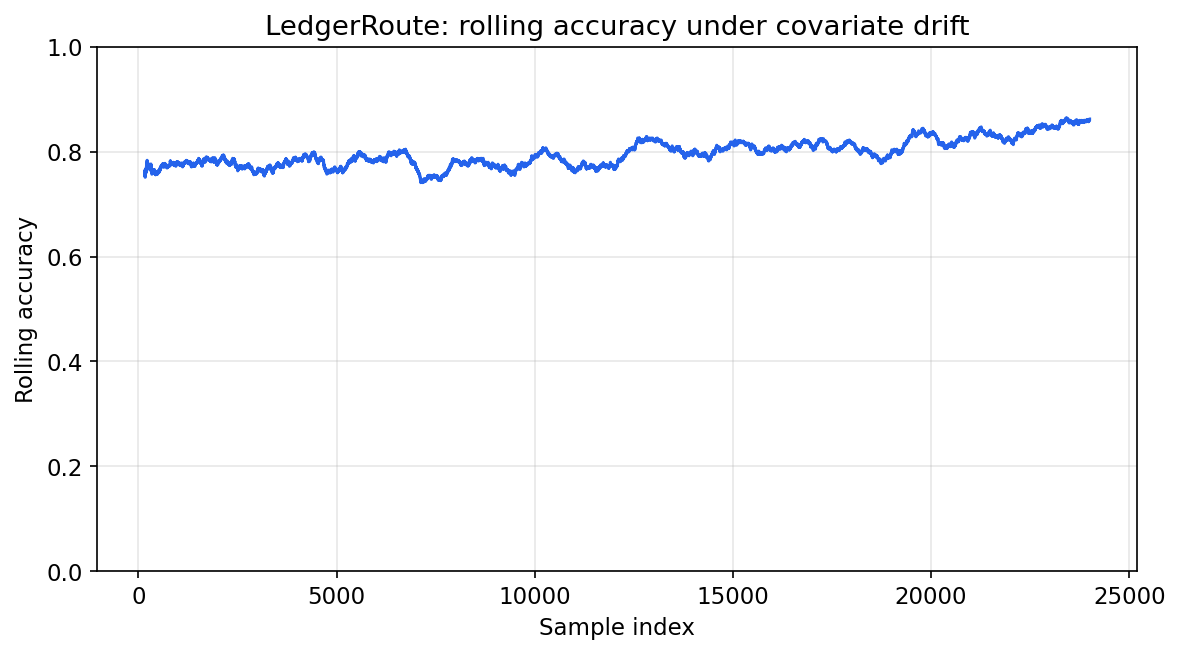
0.74 minimum rolling accuracy
The worst short window on new traffic: not the launch holdout.
Three monitor layers
Features, scores, and delayed labels, each with its own clock.
Join key non-negotiable
Without expense_id → label, outcome drift is invisible.
Questions answered
Production insights
Dashboard trap
Click to revealIf your accuracy chart uses a fixed holdout month, add a second series: rolling accuracy on label-joined production rows only.
Window length
Click to revealMatch rolling windows to label arrival: too short is noise; too long hides a two-week shock.
When to retrain
Click to revealRetrain when outcome layer degrades and labels confirm: not when PSI alone crosses 0.1.
Replay without redeploy
Click to revealReplay last week’s features through the current model offline; if error reproduces, the issue is not serving infrastructure.
Continue this saga
Next chapter: When inputs move.